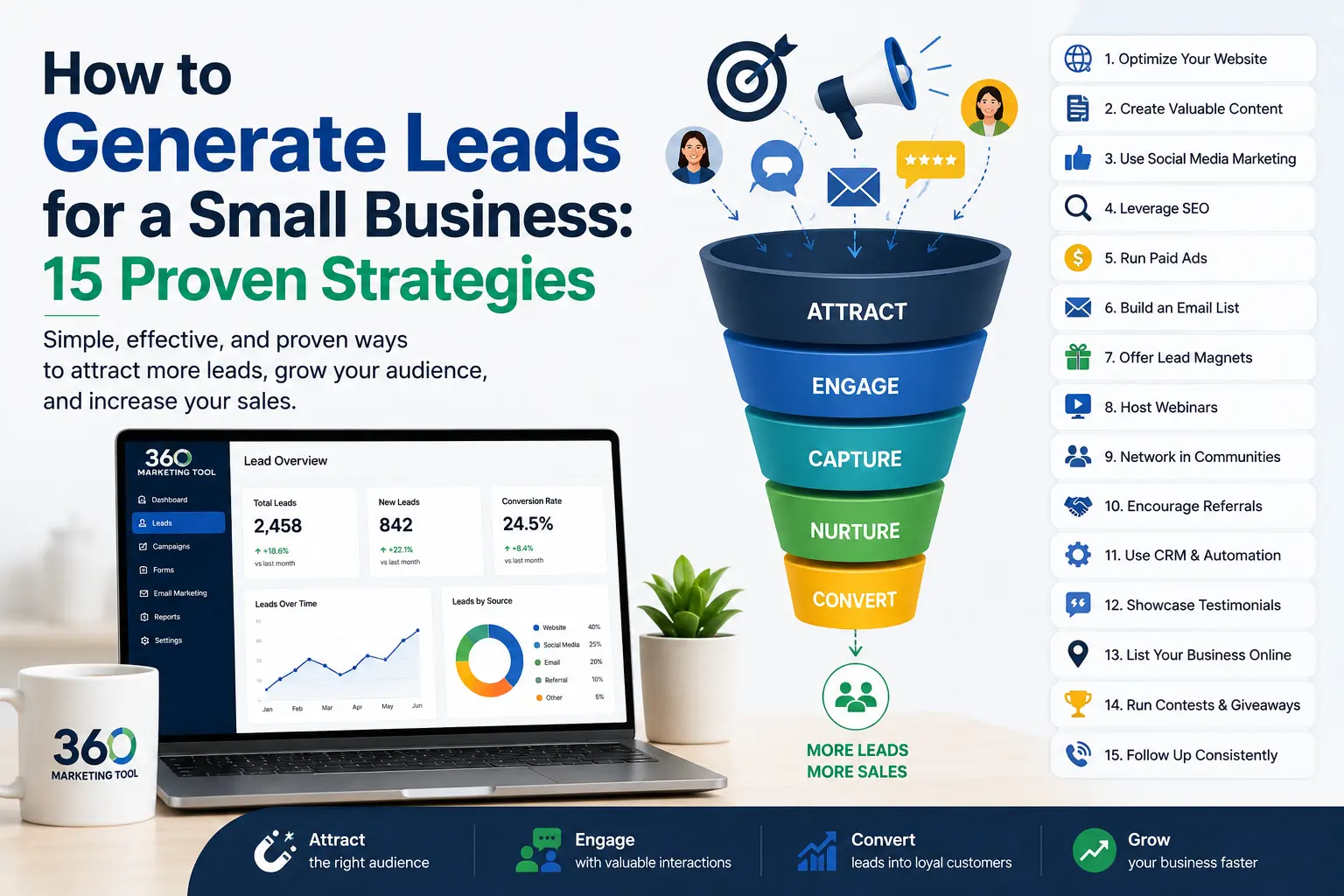
How to Generate Leads for a Small Business: 15 Proven Strategies
Finding new customers is one of the biggest challenges small business owners face. You may have an excellent product or service, but without a steady stream of qualified leads, growing your business becomes difficult.
The good news is that lead generation doesn't have to rely on expensive advertising or complicated marketing tactics. With the right strategy, you can consistently attract people who are genuinely interested in what your business offers. A successful lead generation strategy combines SEO, content marketing, email marketing, social media, and marketing automation to attract qualified prospects consistently.
In this guide, you'll learn 15 proven lead generation strategies that small businesses can use to attract more potential customers, improve conversions, and build a sustainable sales pipeline.
Quick Answer
The best way to generate leads for a small business is by combining multiple marketing channels, including search engine optimization (SEO), content marketing, social media, email marketing, local SEO, landing pages, referral programs, and marketing automation. Focusing on your target audience and providing valuable content helps attract qualified leads who are more likely to become customers.
What Is Lead Generation?
Lead generation is the process of attracting people who are interested in your products or services and encouraging them to share their contact information.
A lead may provide:
- Name
- Email address
- Phone number
- Business information
- Service requirements
- Appointment request
Once someone becomes a lead, you can continue building the relationship through follow-ups, email campaigns, educational content, and personalized communication.
Without lead generation, businesses often rely solely on referrals or repeat customers, making growth unpredictable.
Why Lead Generation Matters for Small Businesses
A consistent lead generation strategy helps you:
- Increase sales opportunities
- Build a predictable customer pipeline
- Reduce dependence on paid advertising
- Improve brand awareness
- Grow your email list
- Build long-term customer relationships
- Generate recurring revenue
The more qualified leads you attract, the more opportunities you create for your business to grow.
15 Proven Strategies to Generate Leads for a Small Business
1. Understand Your Target Audience
Before launching any marketing campaign, identify who you're trying to reach.
Ask questions such as:
- Who is my ideal customer?
- What problems are they trying to solve?
- Where do they spend time online?
- What information are they searching for?
- What motivates them to make a purchase?
Understanding your audience allows you to create marketing that resonates with the right people.
2. Optimize Your Website for Conversions
Your website should do more than provide information. It should encourage visitors to take action.
Include:
- Clear calls to action
- Contact forms
- Quote request forms
- Live chat
- Appointment booking
- Trust signals
- Customer testimonials
Even small improvements to your website can significantly increase lead generation.
3. Create Helpful Blog Content
Content marketing is one of the most effective long-term lead generation strategies.
Instead of focusing only on selling, answer the questions your audience is already asking.
Examples include:
- How-to guides
- Industry tips
- Checklists
- Comparisons
- Beginner guides
- Frequently asked questions
Helpful content builds trust while improving your visibility in search engines.
4. Invest in Search Engine Optimization (SEO)
SEO helps your website appear when people search for solutions related to your business.
Focus on:
- Keyword research
- Technical SEO
- Internal linking
- Quality content
- Mobile optimization
- Fast loading pages
- Local SEO
Ranking higher in search results can generate qualified leads without paying for every click.
5. Build High-Converting Landing Pages
Landing pages are designed around a single goal.
Instead of sending visitors to your homepage, create dedicated pages for:
- Free consultations
- Product demos
- Downloadable guides
- Newsletter signups
- Free trials
- Special offers
A focused landing page typically converts better than a general website page.
6. Use Email Marketing to Nurture Leads
Not every visitor is ready to buy immediately.
Email marketing helps you stay connected until they're ready to make a decision.
Send:
- Welcome emails
- Educational content
- Promotions
- Product updates
- Case studies
- Customer success stories
Consistent communication keeps your business top of mind.
7. Claim and Optimize Your Google Business Profile
For businesses serving local customers, your Google Business Profile is one of the most valuable lead generation tools.
Optimize your profile by:
- Adding accurate contact information
- Selecting the right business categories
- Uploading high-quality photos
- Responding to reviews
- Posting regular updates
A well-maintained profile can increase local visibility and drive more inquiries.
8. Encourage Customer Reviews
Positive reviews build trust and influence purchasing decisions.
Ask satisfied customers to leave reviews on platforms such as:
- Industry-specific directories
Respond professionally to every review, whether positive or negative.
9. Offer Valuable Lead Magnets
People are more likely to share their contact information when they receive something useful in return.
Examples include:
- Free guides
- Templates
- Checklists
- Webinars
- Free audits
- Discount coupons
Choose lead magnets that solve a specific problem for your audience.
10. Build a Strong Social Media Presence
Social media allows you to connect with potential customers where they already spend time.
Share:
- Educational posts
- Customer success stories
- Short videos
- Industry insights
- Tips and tutorials
- Behind-the-scenes content
Consistency matters more than posting on every platform.
11. Launch Referral Programs
Happy customers are often your best marketers.
Offer incentives for referrals, such as:
- Discounts
- Account credits
- Exclusive offers
- Loyalty rewards
Referral marketing often produces highly qualified leads because they come from trusted recommendations.
12. Use Marketing Automation
As your business grows, manually managing every lead becomes difficult.
Marketing automation helps you:
- Capture leads
- Send automated emails
- Assign follow-up tasks
- Track customer interactions
- Score leads
- Measure campaign performance
Automation improves efficiency while ensuring no lead is overlooked.
13. Run Paid Advertising Strategically
Paid advertising can generate results quickly when managed effectively.
Popular platforms include:
- Google Ads
- Facebook Ads
- Instagram Ads
- LinkedIn Ads
Start with a clear budget, monitor performance, and continuously optimize your campaigns based on results.
14. Network With Other Businesses
Building relationships with complementary businesses can create new lead opportunities.
Examples include:
- Local partnerships
- Industry associations
- Community events
- Business networking groups
Strategic partnerships often produce referrals that are already qualified.
15. Measure and Improve Your Results
Lead generation isn't a one-time activity.
Track important metrics such as:
- Website traffic
- Conversion rate
- Cost per lead
- Email open rates
- Click-through rate
- Landing page performance
- Customer acquisition cost
Review your data regularly and adjust your strategy based on what works best.
Common Lead Generation Mistakes
Many businesses struggle because they:
- Target everyone instead of a specific audience.
- Ignore SEO.
- Have weak calls to action.
- Don't follow up with leads promptly.
- Publish inconsistent content.
- Use complicated contact forms.
- Fail to measure campaign performance.
- Stop marketing after generating initial interest.
Avoiding these mistakes can significantly improve your results.
Which Lead Generation Strategy Works Best?
There isn't a single strategy that works for every business.
The most successful businesses combine several approaches, including:
- SEO
- Content marketing
- Email marketing
- Local SEO
- Social media
- Landing pages
- Referral marketing
- Marketing automation
Working together, these channels create a reliable system for attracting and converting potential customers.
How 360 Marketing Tool Helps Small Businesses Generate More Leads
Managing multiple marketing channels can quickly become overwhelming.
360 Marketing Tool brings together essential marketing features in one platform, helping businesses manage campaigns, organize customer data, automate marketing tasks, and track performance more efficiently.
Instead of switching between multiple tools, businesses can streamline their marketing efforts, improve lead management, and build stronger relationships with potential customers through a centralized solution.
Whether you're growing your first customer base or scaling an established business, having an integrated marketing platform can simplify your lead generation process.
Frequently Asked Questions
What is the fastest way to generate leads for a small business?
Paid advertising can produce leads quickly, while SEO and content marketing provide more sustainable long-term growth. Combining both approaches often delivers the best results.
How can I generate leads without spending a lot of money?
You can generate leads through SEO, blogging, social media, referral programs, Google Business Profile optimization, and email marketing without requiring a large advertising budget.
What is a qualified lead?
A qualified lead is someone who has shown genuine interest in your products or services and matches the characteristics of your ideal customer.
Why is SEO important for lead generation?
SEO helps your business appear in search results when potential customers are actively looking for solutions, making it one of the highest-intent marketing channels.
How long does it take to see results from lead generation?
Paid campaigns may generate leads within days, while SEO and content marketing typically take several months to build momentum. Consistency is key to long-term success.
Final Thoughts
Generating leads consistently is one of the most important factors in growing a successful small business. While there is no single tactic that guarantees results, combining SEO, valuable content, email marketing, social media, local optimization, landing pages, and marketing automation creates a reliable system for attracting qualified prospects.
Focus on understanding your audience, solving their problems, and providing value at every stage of the customer journey. Over time, these efforts will help you build trust, strengthen your brand, and create a steady flow of new business opportunities.
If you're looking for a simpler way to manage campaigns, organize leads, and automate your marketing activities, 360 Marketing Tool provides an all-in-one platform designed to help small businesses market more efficiently and grow with confidence.
What to read next